
Baseboard for the Cubieboard

A developer board like the Cubieboard is very extensible and can connect to a variety of devices including sensors. To simplify the connection to additional devices, it is common to have an additional printed circuit called daughterboard or baseboard.

edit (15 Jan 2013): This board is a baseboard, because it acts as a base to the Cubieboard. The Cubieboard can take power from this baseboard.
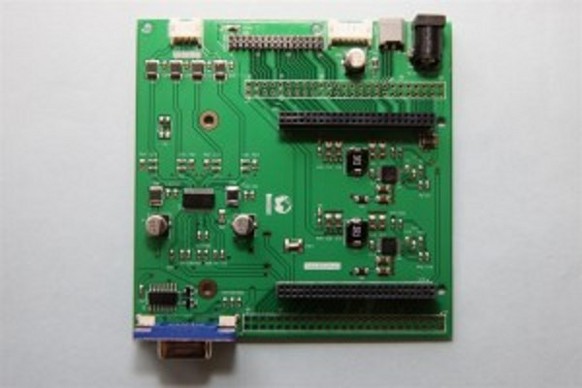
George Ioakimedes informs us of the following baseboard daughterboard design:

  • 2mm pitch female sockets to accept Cubieboard
  • All 96 Cubieboard pins brought out to 0.100″ pitch headers
  • 4-pin power header to match optional power input header on Cubieboard
  • LVDS header w/ separate LCD Backlight connector to match low cost LVDS cable
  • 4-wire touch screen connector
  • Standard 2.5mm DC jack, 12V-18V input
  • Onboard 5.0V switching regulator to power the Cubieboard and provide 3A (available on 0.100″ header)
  • Onboard 3.3V switching regulator to power LCD and provide 3A (available on 0.100″ header)
  • 15W Stereo Class D Audio Amplifier
  • VGA circuit and HD15 connector
Daughterboard design for the Cubieboard

Daughterboard Baseboard design for the Cubieboard, by George Ioakimedes

This post will be updated as soon as the purchase details are available.
simos (5 Posts)


15 comments on “Baseboard for the Cubieboard

  1. rtalcott on said:

    looks nice AND useful!
    rt

  2. it was better to have 2,54mm (0.100 inch) pitch directly on cubieboard, this “double step” 2.0 -> 2.54mm make me furious!

    »»» You can join the Google Group for Cubieboard at https://groups.google.com/forum/#!forum/cubieboard and discuss with the designer of the baseboard and the rest of the community. If you can contribute, we can make an excellent baseboard for the Cubieboard. [-- Simos]

  3. Standard 2.5mm DC jack, 12V-18V input
    Is it possible to increase the input voltage tolerance up to 20 Volt?

    There are a lot of Portable PC power supplies available in my scrap bins that provides 18.5 Volts :-)

    • GeorgeIoak on said:

      The switching regulators have a maximum input voltage of 18V with a maximum input of 20V. There are ferrite beads before the input of each switcher which will drop the voltage seen at the switcher slightly. A polyfuse might drop it even a bit more, if I have time to test I will check this for you.

  4. Hello
    I want use lvds, if use this board no need Enable in kernel?

  5. dariush on said:

    Hi,
    When this useful board will be available for sale?
    Thanks.

    • Join the discussion list in order to keep in touch with the development of the baseboard.
      Up to now, George produced several testing baseboards and after the successful test, more will be produced.
      If you are happy to be a tester, you can ask for one of the early models.

      The discussion group is at cubieboard.org/contact

  6. hassan memari on said:

    my designing extension Cubieboard
    http://www.iranmicro.ir/forum/showpost.php?p=60849&postcount=233
    OR
    http://www.iranmicro.ir/forum/showpost.php?p=60927&postcount=248

    • Thanks Hassan!

      You can join the mailing list/forum for the Cubieboard at http://www.cubieboard.org/contact and post the design for further discussion.

  7. Chris Symons - Effective Control Systems on said:

    We are looking for a daughter board for the cubieboard that has a 5V regulator as well as an additional network connector. We need the Cubie board to act as a 2 port switch. Has anyone done anything along these lines or have any suggestions on how best to implement a second network point on the board.

    • Join the discussion list for this technical question.
      See Contact in this website on how to join.
      George, who designed the baseboard, might be able to help you.

  8. Amol Palshetkar on said:

    Can u share the schematics or the list of sensors or interface & price of the base board & link to purchase it

  9. Galih Abdul Fatah Maulani on said:

    Nice…